Optimizing Human Resource Information System (HRIS): Redesigning the Performance Management Modules
Industry
Human Resources
Client
Astra
Platform
Web
Background
At Toyota Astra Motor, HRIS is a centralized digital platform that supports end to end employee management, from workforce planning and performance tracking to career development. The system functions as the backbone of HR operations, ensuring that all processes remain standardized, transparent, and aligned with company policies. As organizational needs expanded, HRIS evolved into two main modules: Performance Management and Organization Management. This project focuses on the Performance Management module, which consists of two key submenus: IPP (Individual Performance Plan) and IDP (Individual Development Plan). These processes run through three core phases: Plan, Mid, and Final. However, the current dashboard and forms still present several usability issues: the forms appear too long, the information structure lacks clarity, and certain sections are difficult for users to understand. These issues significantly increase *time to complete* and add unnecessary cognitive load, making the input, review, and decision making processes slower and less efficient. To address this, a revamp is being carried out to simplify the interface, improve information hierarchy, and create a more intuitive user flow. Overview of the phases: - Plan Phase: The Initiator (employee) completes the IPP and IDP based on performance targets and development needs, including the Career Aspiration section (rotation and mobility preferences). Once completed, the form is submitted to the approver (HR/Section Head, Dept Head, Div. Head) for review, approval, or revision. - Mid Phase: The mid-year phase is used to monitor the progress of IPP and IDP. Adjustments can be made if necessary, based on discussions between the initiator and the approver. - Final Phase: The final phase includes a comprehensive evaluation of individual performance and development outcomes. The approver conducts the final assessment, which becomes the basis for managerial decisions such as promotions, advanced training assignments, or future career planning. With this revamp, the Performance Management module is expected to become more user friendly, clearer in its information structure, and more effective in supporting employee development and strategic decision making.
What Next
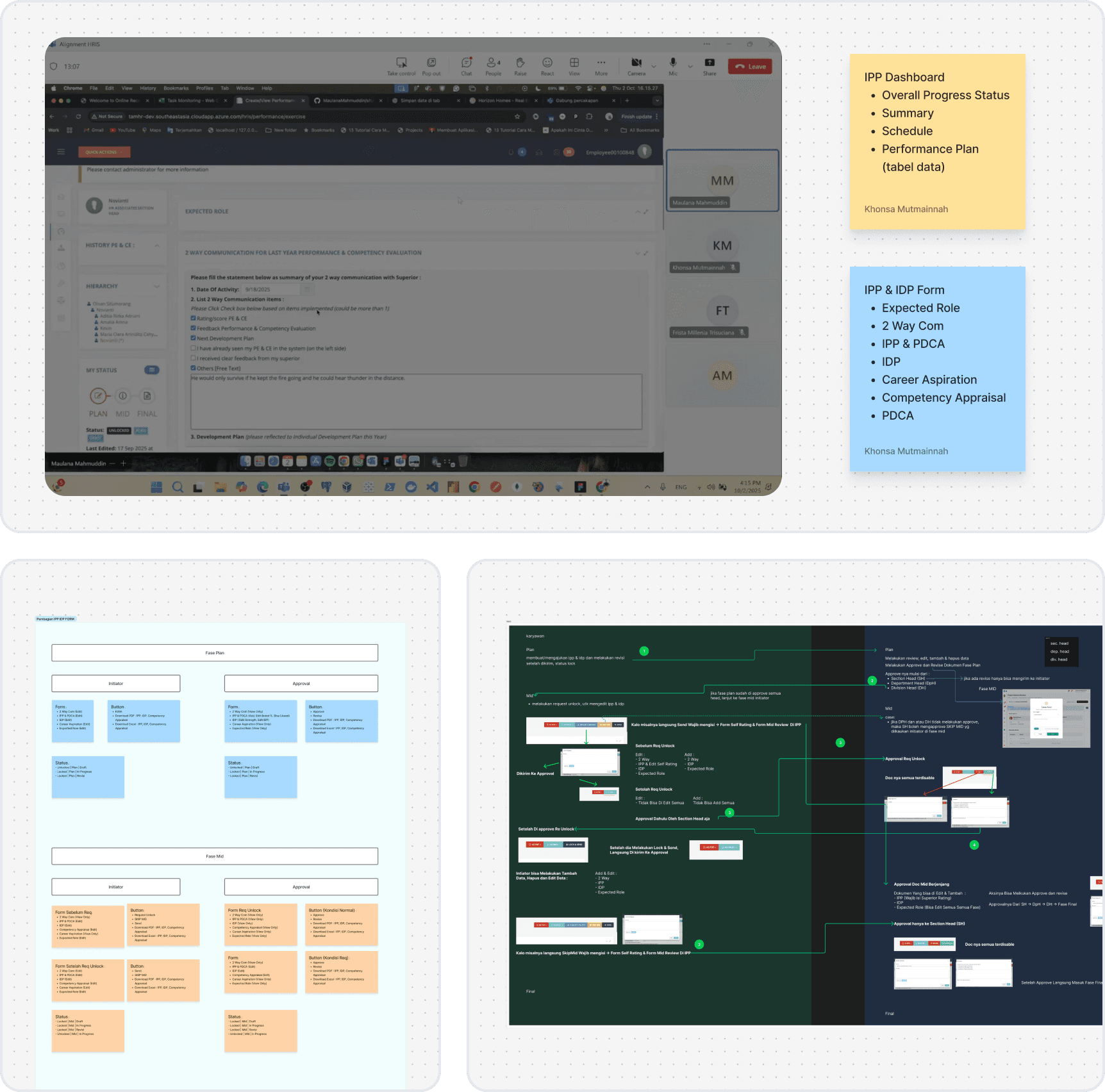
This project involved a team of four members: two designers and two business analysts (BA). In the initial phase, we conducted a Discovery process to align our understanding of the current system, user needs, and key challenges.
Define The Problem
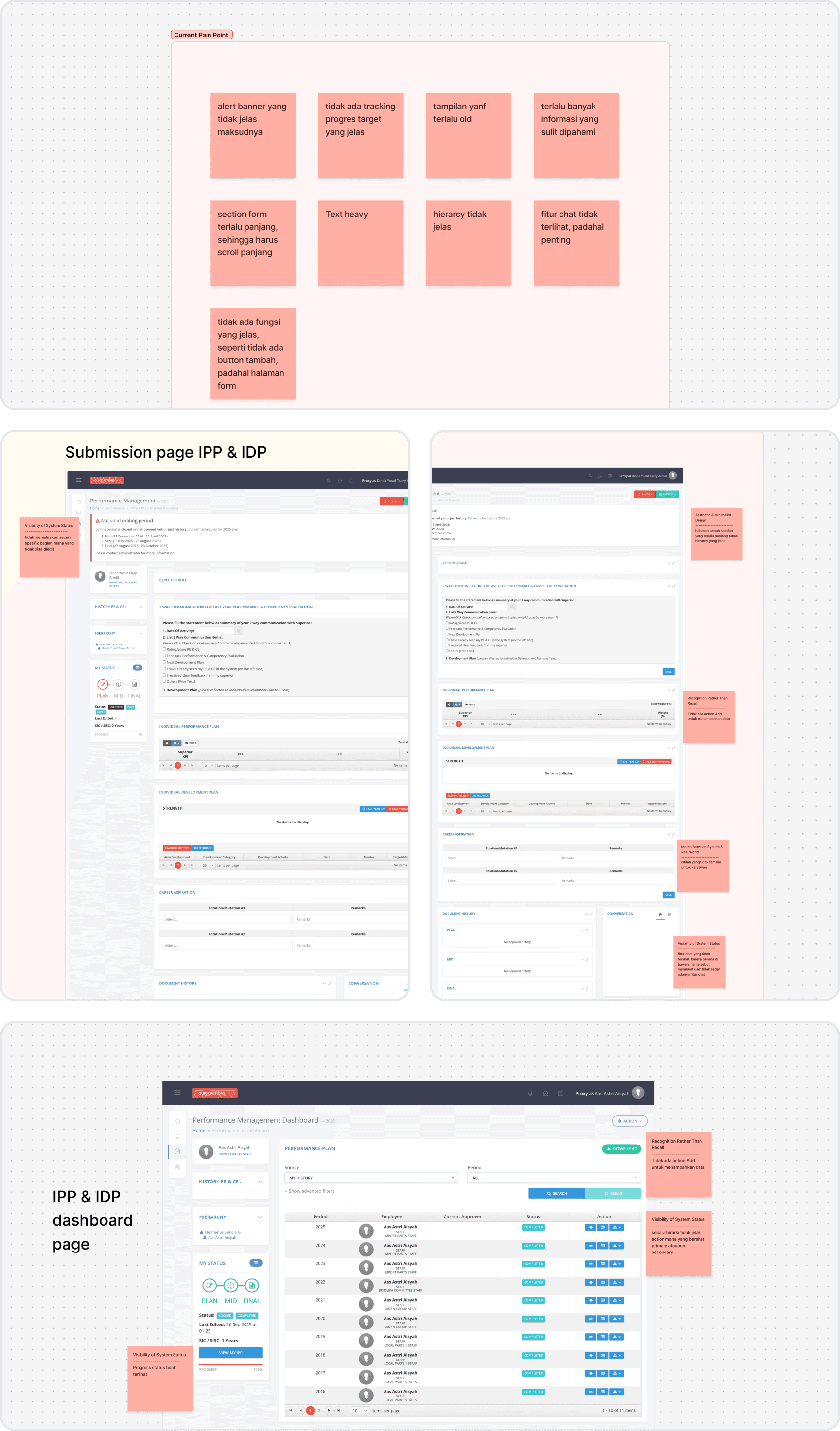
After a series of alignments, we identified that employees and approvers struggle to complete the IPP & IDP process due to information overload, unclear content hierarchy, and limited visual guidance throughout the performance evaluation flow. These issues create confusion, increase user effort, and contribute to a higher likelihood of errors.
Through heuristic evaluation (HE) approach and a detailed system audit, four key problem areas emerged:
Lack of Clarity on Status and System Feedback
Overloaded & Unstructured Layout
Unclear Actions and Navigation
Terminology Not Aligned With User
Objective
This project aims to increase the efficiency of completing and approving IPP & IDP by 30–40% through workflow simplification, reduction of unnecessary steps, and improvements in information hierarchy. The revamp also focuses on reducing cognitive load and enhancing user experience, enabling both employees and approvers to understand and complete tasks more easily.
With these improvements, the system is expected to enhance input accuracy, streamline the approval process, and support more informed decision-making, while providing a more user-friendly and scalable platform for future HR needs.
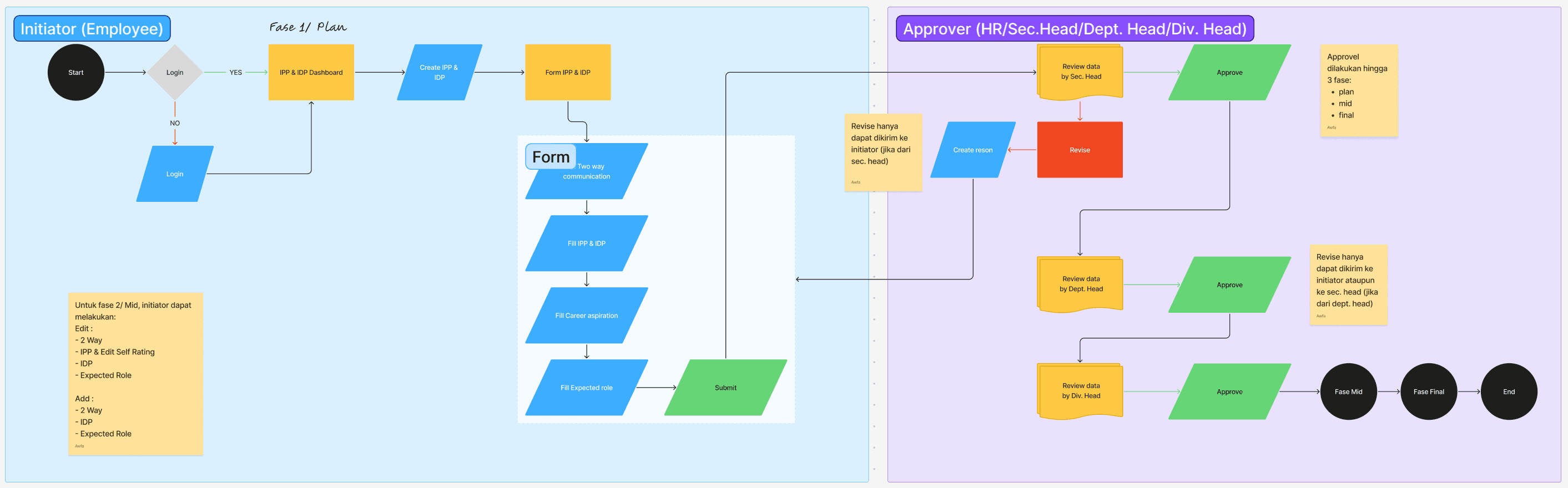
After defining the problem and establishing the objectives, I developed the user flow to map out the end to end interactions across all user roles. This flow helped clarify how initiators and approvers navigate each step from submission to review and approval, ensuring the process is logical, streamlined, and free of unnecessary friction. By visualizing the entire journey, I was able to identify bottlenecks and refine the workflow to improve overall efficiency.
High Fidelity Design
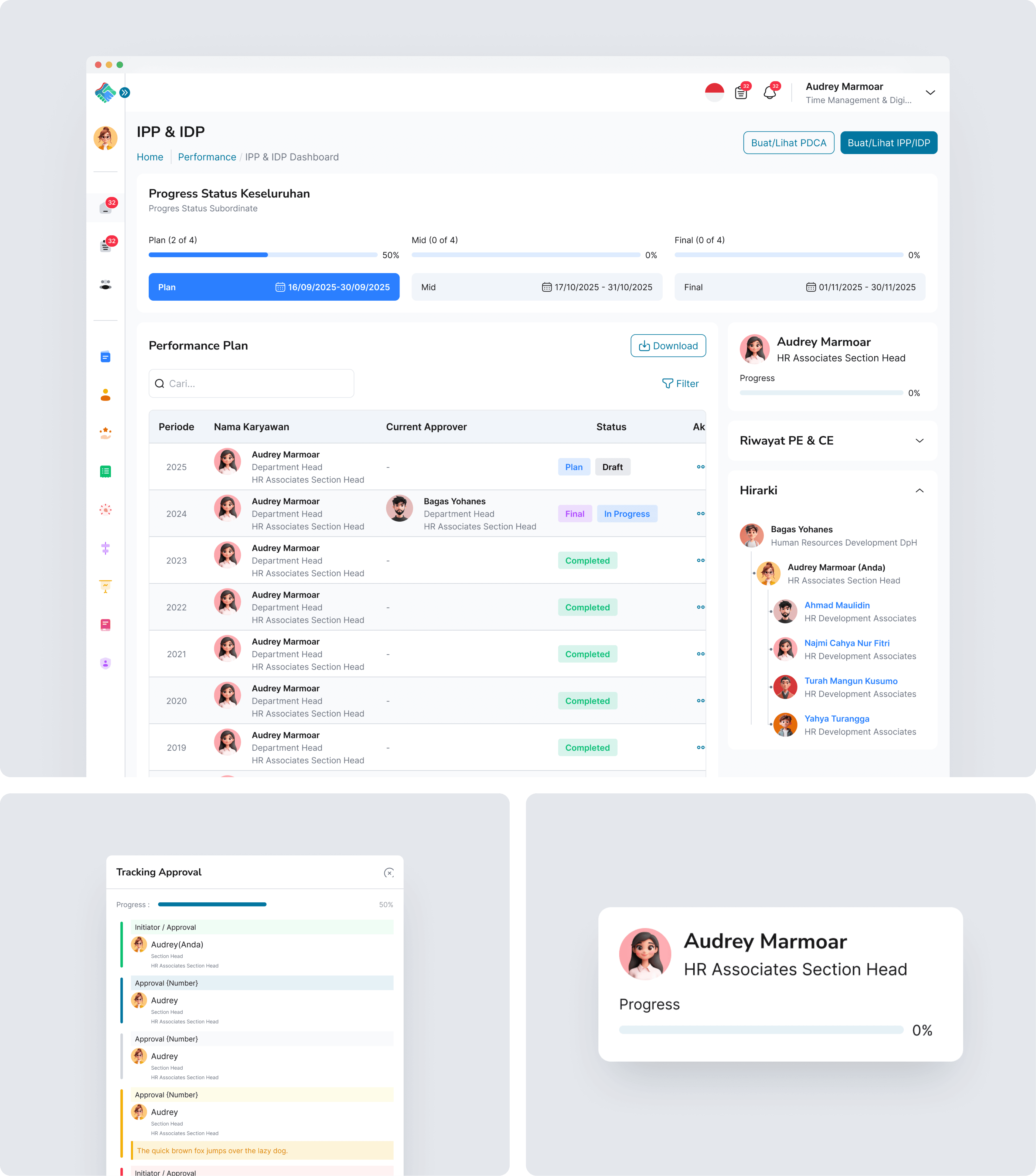
IPP & IDP Dashboard is a monitoring dashboard for HR to oversee the implementation of employees’ Individual Performance Plans and Individual Development Plans. It enables HR to track progress across each evaluation phase, monitor approval statuses, review performance plan history per employee, and understand organizational hierarchy, ensuring performance evaluation and employee development processes are well-controlled, consistent, and transparent.
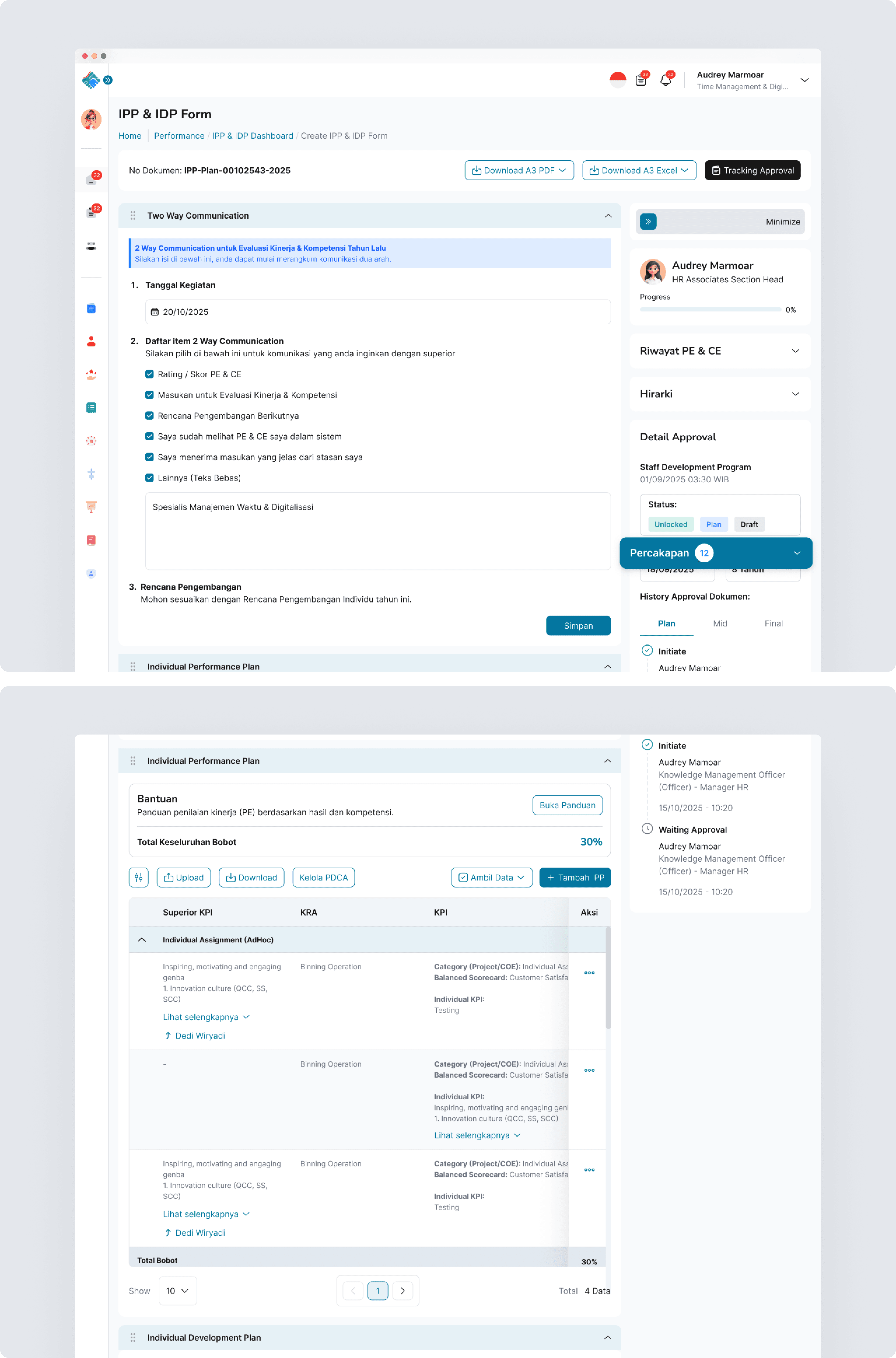
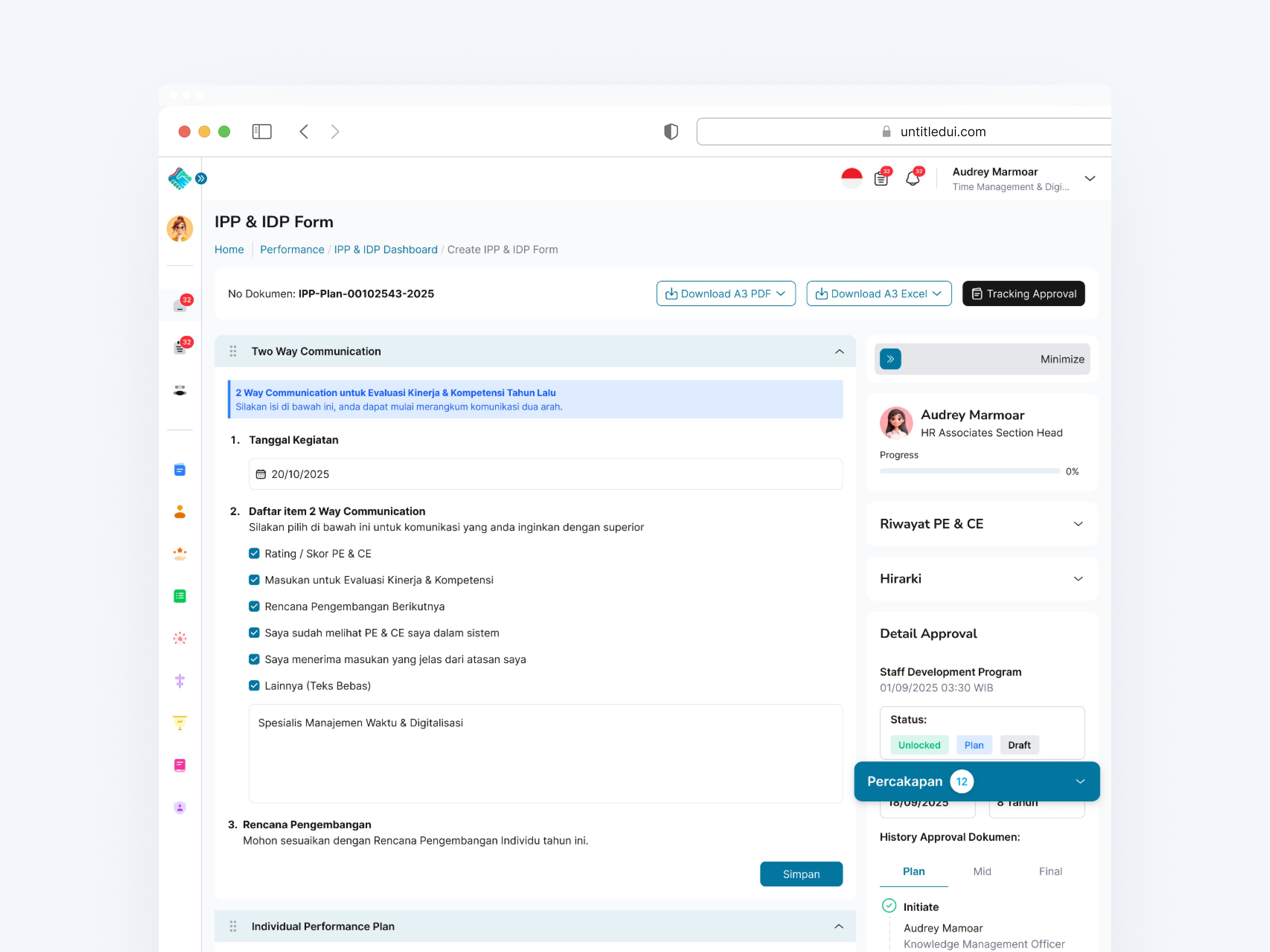
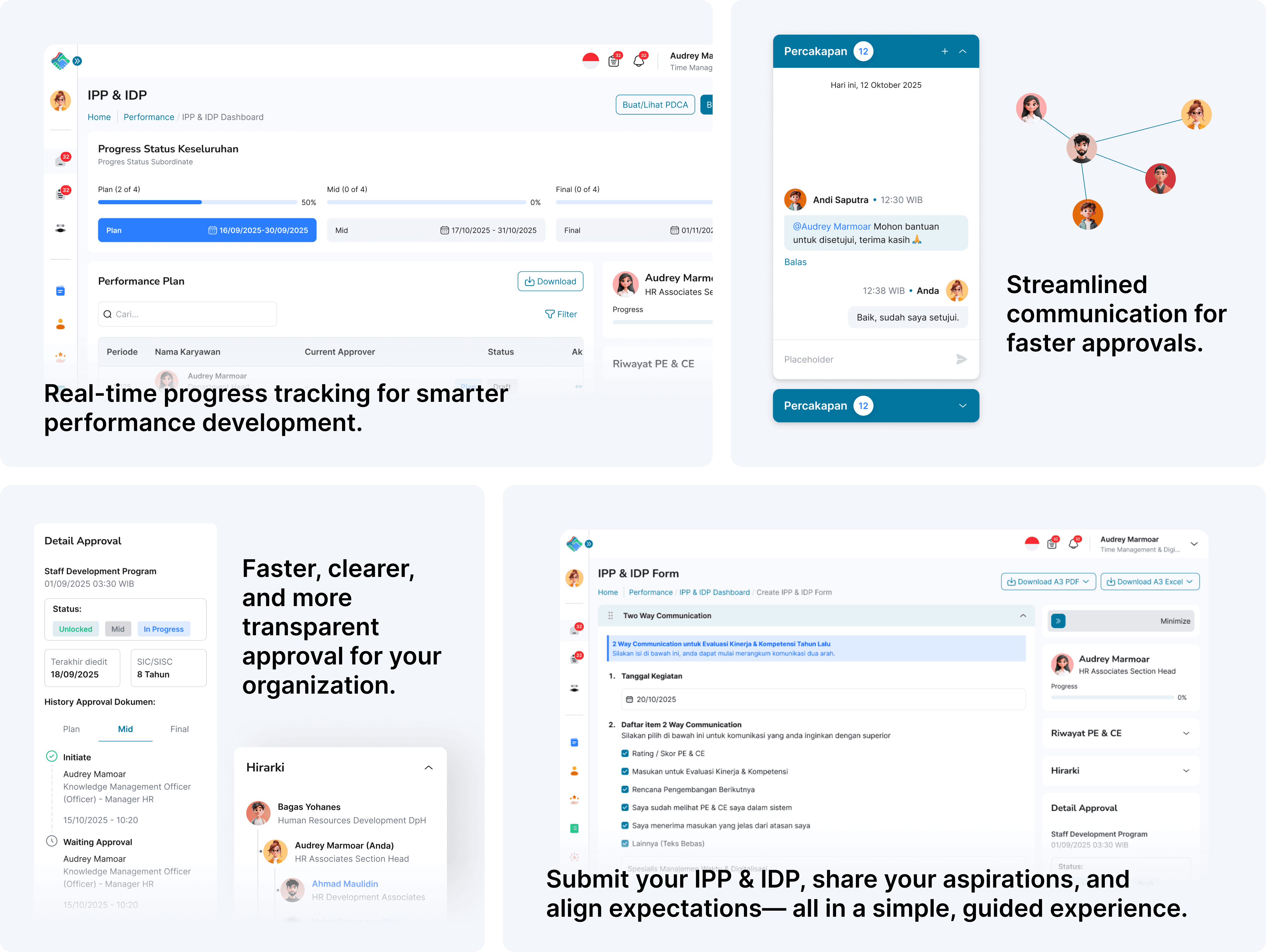
This image represents the IPP & IDP Form page from the employee’s point of view, where employees submit their Individual Performance Plan and Individual Development Plan. Through this page, employees can define performance and development goals, engage in two-way communication with their supervisors, and submit performance and competency evaluations in a structured flow, with clear visibility into KPI details, weight distribution, approval status, and approval history to ensure a transparent and well-documented submission process.
Conclusion
The revamp of the Performance Management module (IPP & IDP) within Toyota Astra Motor’s HRIS successfully addressed core challenges related to system complexity, information overload, and unclear workflows for both employees and approvers.
By focusing on clarity, structure, and role-based experiences, the new design transformed a previously heavy and confusing process into a more guided, efficient, and understandable workflow. Beyond improving usability, the redesign strengthened HRIS as a strategic tool that supports better performance evaluation and data-driven decision-making.
Outcome
Key results achieved through this redesign include:
Approximately 30–40% reduction in IPP & IDP completion time
Achieved through simplified workflows, progressive disclosure, and improved information hierarchy.
Reduced cognitive load for users
Information is presented contextually based on phase and user role, making tasks easier to understand and complete.
Faster and more structured approval process
Approvers can review, evaluate, and make decisions more efficiently with clearer layouts and actions.
Improved UX consistency across Performance Management modules
Helping users build a stable mental model when navigating between features.
Scalable design foundation for future HRIS enhancements
The new structure enables easier expansion without reintroducing usability issues.
Lessons Learned
Designing enterprise systems is about managing complexity, not removing it
The key challenge lies in structuring information so complexity feels manageable for users.
Role-based design is critical in multi-stakeholder systems
Employees and approvers have different goals, contexts, and decision-making needs.
Terminology plays a major role in usability
Misaligned language can create confusion even when workflows are logically sound.
Clear user flows improve cross-functional collaboration
Visualizing the end-to-end journey helped align designers, business analysts, and product stakeholders.
Good UX supports business decisions, not just interface quality
A well designed system enables faster, more accurate evaluations and better strategic outcomes.